5 min read
Going Above B10: What to Check Before Increasing Your Biodiesel Blend
If you operate a high-flow truck diesel site, the math on raising your biodiesel blend usually starts with the price spread. When biodiesel and...
7 min read
United Uptime
:
Updated on June 10, 2026
It is a busy Saturday on the forecourt. Cars are stacked three deep at every island. A week later, a regular customer calls, upset, because his bank flagged fraud and traced it back to a charge at your store. You walk the lot. Nothing looks broken. Nothing looks off. And that is exactly the problem.
KEY TAKEAWAYS:
Skimmer crews follow big events and high traffic. With World Cup matches running across U.S. host metros this summer, every card-present pump is a bigger target.
Skimmers come in two forms: an external overlay on the card reader or keypad, and an internal device wired inside the cabinet that sends card data over Bluetooth or cellular. The internal kind is invisible from the outside.
A daily walk, serial-numbered tamper-evident seals on the panel doors, unique cabinet locks, and clear lines of sight are the cheapest defenses you have.
If you find one, do not touch it. The pump is now a crime scene. Take it offline, call your local police, preserve your camera footage, and keep a record of what you found.
Big events move a lot of people, and a lot of cards, through fuel sites in a short window. The 2026 FIFA World Cup is doing that right now across U.S. host metros, and the people who install card skimmers know it. The Texas Financial Crimes Intelligence Center has put out an advisory urging retailers to step up inspections of every card-present terminal during the tournament. Their estimate: a single skimming device can hit hundreds of cardholders and cause up to $1 million in harm.
We are anchoring this in Texas because that is home for a lot of our operators and the advisory is Texas-issued. But the same caution applies anywhere the crowds go: Atlanta, Boston, Dallas, Houston, Kansas City, Los Angeles, Miami, New York and New Jersey, Philadelphia, the San Francisco Bay Area, and Seattle. If you run sites near any host metro, or along the highways feeding them, this is your window to pay closer attention.
This post covers what a skimmer actually is, why events like this raise your risk, how to spot a compromised pump, how to make your dispensers a harder target, and what to do the moment you find something.
A skimmer is a device that steals card data at the point where a customer pays. At a fuel dispenser, they show up two ways.
An external skimmer sits on top of the real hardware. It is an overlay placed over the card reader slot or a thin film over the keypad, sometimes paired with a tiny pinhole camera. These you can sometimes catch with your eyes and hands.
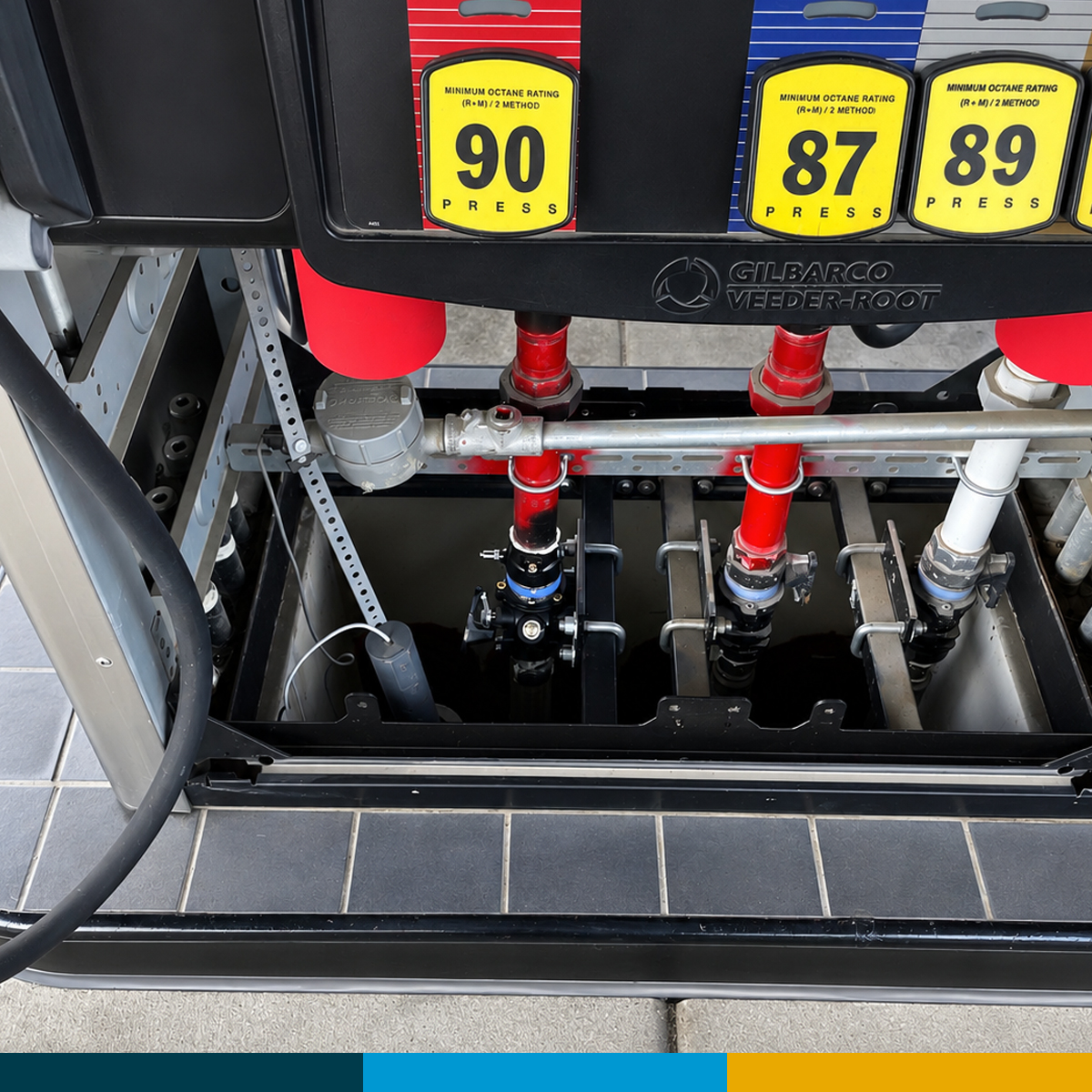
An internal skimmer, sometimes called an inline device, is wired inside the dispenser cabinet, connected directly to the card reader. It relays card numbers almost in real time over Bluetooth or a cellular connection, so the thief never has to come back to the same pump. This is the dangerous one, because from the customer side and the curb, the pump looks completely normal.
The skimmer that costs you the most is the one you cannot see from the outside. That is why what is behind the panel door matters as much as what is on the face of the pump.
Skimming is a volume game. The more cards that run through a compromised pump, the bigger the payoff before anyone notices. A tournament that pulls tens of thousands of visitors into a metro, fills the highways, and runs for weeks is exactly the environment these crews look for.
Two things work against you during an event. First, your forecourt is busier, so an unfamiliar face opening a panel for thirty seconds blends in with the rush. Second, your team is slammed, so the daily habits that catch tampering get skipped. Thieves count on both.
You will not always catch an internal skimmer by looking. But there are signals worth training your team to notice.
Train your closing crew to compare pumps against each other. If one reader does not match the rest, that position comes out of service until someone qualified looks at it.
A skimmer does not trip an alarm. It quietly runs until a bank or a customer connects the fraud back to your address. By then the damage is done, and it lands on you in several ways.
Your customers lose money and trust, and they remember where it happened. The affected dispenser becomes a crime scene and comes out of service while police process it, which is lost selling time at your busiest moment. And depending on the situation, you may face questions about payment-terminal security standards and your own records of how the equipment was maintained.
None of that is a fine you can predict or a number we are going to invent for you. The point is simpler: the cost of a few minutes of daily attention is a fraction of the cost of cleaning up after a breach.
You cannot make a dispenser skimmer-proof. You can make it enough of a hassle that crews move on to an easier site.
WHAT TO DO THIS WEEK:
Walk every pump and check that the panel-door security seals are intact.
Compare each card reader against the others on your lot. Flag any that does not match.
Confirm your cameras cover every fueling position and the line of sight is clear.
Make sure every shift knows who to call the moment something looks wrong.
Check local and state requirements for payment-terminal security and inspection in your area. Requirements and reporting channels vary, and this is general guidance, not legal advice.
If you or an employee finds a skimmer, the steps matter, because the pump is now evidence.
Good records do two things here. They help you prove the equipment was being watched, and they make it obvious the moment something changes.
At a minimum, keep a simple log of which pumps were checked and when, the serial numbers on your tamper-evident seals, photos of any tampering, and the service records for each dispenser. When a qualified technician works on a payment terminal or card reader, that visit should be documented too, with tech notes, photos, and the parts detail of what was used and what is required for return. The cleaner that paper trail is, the less you have to reconstruct under pressure if an investigator or a card brand comes asking.
A tournament is a good problem to have. More traffic means more sales. It also means more cards through your pumps and more attention from people who want to steal them. The operators who come through clean are not the ones with the fanciest equipment. They are the ones with a habit: a daily walk, sealed panels, clear cameras, and a team that knows what to do when something looks wrong.
The work you document now, the seals you log and the checks you record, is the work you do not have to chase down later when someone asks what changed.
If you want a qualified set of eyes on your dispensers and payment terminals before your busiest weeks, Contact us to schedule a security and service check at your sites.
How can I tell if my gas pump has a skimmer?
Look for a card reader that does not match the other pumps on your lot, a loose or crooked reader housing, a card that is suddenly hard to insert, or a panel door with a broken or "VOID" security seal. External skimmers can sometimes be seen or felt. Internal ones cannot, which is why sealed panels and daily checks matter so much.
Where do skimmers hide on a fuel dispenser?
Two places. On the outside, as an overlay on the card reader or a film over the keypad, sometimes with a hidden pinhole camera. On the inside, wired to the card reader behind the panel door, sending card data over Bluetooth or cellular. The internal kind is invisible from the curb.
Do chip readers stop skimmers at the pump?
They help. EMV chip transactions and encrypted readers make stolen card data much harder to use, but they do not make a pump skimmer-proof. Pair them with tamper-evident seals, unique locks, cameras, and daily inspections. Offering mobile and contactless payment helps too, since those transactions never expose the real card number to a skimmer.
What do I do if I find a skimmer on my pump?
Do not touch it. Take that dispenser out of service, call your local police, and preserve your camera footage. In Texas, report it to the Texas Financial Crimes Intelligence Center too. Keep a written record of what you found and when.
Why would the World Cup increase skimming at my gas station?
Skimming pays off based on volume. A tournament that floods a metro with visitors and traffic for weeks means far more cards running through nearby pumps, which is exactly the high-traffic, high-distraction setting these crews target.
5 min read
If you operate a high-flow truck diesel site, the math on raising your biodiesel blend usually starts with the price spread. When biodiesel and...
3 min read
The storm passes. The lights come back on. Customers start pulling in. And somewhere on your forecourt, a small thing is starting that will turn into...
3 min read
The work is done. The technician's truck is pulling out of the lot. Your dispenser is running, your alarm is cleared, your sump is dry. And then a...